Smoke tree Cotinus coggygria 'Royal Purple' has a high ornamental value and its pharmacological and phytochemical constituents have a great variety of biological activities (antioxidative, antiviral, antibacterial, antifungal, anticancer, antigenotoxic, hepatoprotective and anti-inflammatory properties). For its propagation, there are three methods: seed propagation, cutting propagation and micropropagation.
Seed propagation is a common method to produce a lot of progenies but these are genetically heterogeneous. In addition, it may result in the production of male plants that cannot produce the attractive inflorescences typical of this ornamental. On the other hand, C. coggygria is known as a difficult-to-root plant species in conventional cutting propagation as well as in micropropagation.
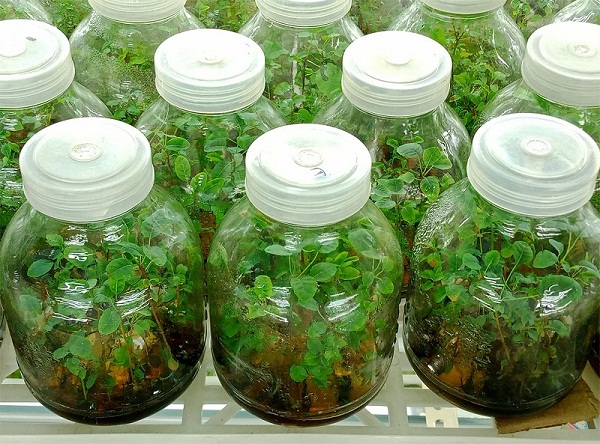
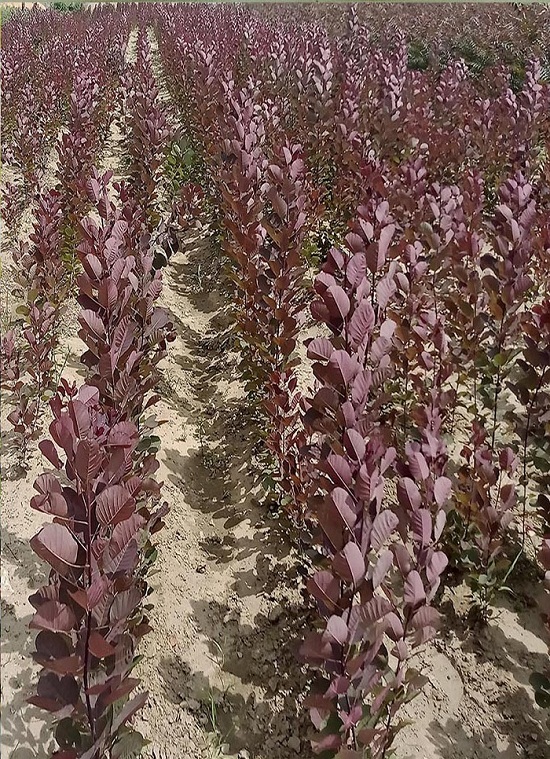
We have developed an efficient micropropagation protocol for C. coggygria ‘Royal Purple' by tissue culture. Micropropagation consisted of four stages: in vitro shoot induction, multiplication, rooting and ex vitro acclimatization. First, axillary shoots from dormant twigs dipped in water were sterilized with 70% ethanol for 20 s and with 0.1% HgCl2 solution for 6 min, soaked in 150 mg/L vitamin C solution for 10 min and then inoculated on WPM medium supplemented with 1.0 mg/L 6-BA, 0.05 mg/L NAA, 1000 mg/L PVP, 3% sucrose and 0.6% agar. In vitro shoots were multiplied on modified MS medium (NH4NO3 1100 mg/L) enriched with 1.0 mg/L 6-BA, 0.05 mg/L NAA, 1000 mg/L PVP, 3% sucrose and 0.6% agar and were rooted on 1/2 MS medium fortified with 1.5 mg/L IBA, 1000 mg/L PVP, 2% sucrose and 0.6% agar. In vitro tissue culture plantlets (Photo 1) were preliminarily hardened under greenhouse condition for 3~5 days, and then were grown on the acclimatization medium which was a mixture of vermiculite, peat, carbonized rice husk, fermented sawdust and coal ash (the volume ratio was 2:2:4:1:1) for 35 days. The greenhouse-acclimatized plantlets were moved to outdoor conditions, subjected to light-hardening for 7-9 days under sunlight conditions and then transplanted to the soil, yielding the survival rate of 95% (Photo 2).
The establishment of a reliable tissue culture method has allowed for the successful regeneration of many plants from a single explant, resulting in the potential for mass propagation of this cultivar.
The result has been published in "Plant Cell, Tissue and Organ Culture " (Vol 116, No 4, 2025) under the title of "Improved culture conditions for successful micropropagation of smoke tree Cotinus coggygria ‘Royal Purple' through direct organogenesis"(https://dx.doi.org/10.1007/s11240-025-03114-2).