Quantum networks are functional components to transport single photons with information to spatially separated users. As a basic key element of the quantum networks is a quantum router, which consists of quantum channels and quantum nodes. The important topic in the considerations of the quantum router is the efficient routing of photonic signals in quantum channels.
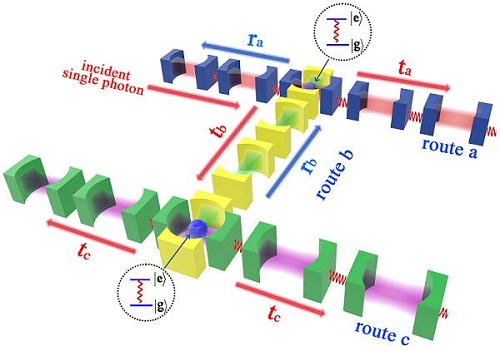
We proposed a new model to realize a single photon router composed of the 工-shaped CRWs with two QDs and theoretically investigated it's routing properties of single photons based on the discrete scattering equations, where the two QDs are embedded in two nodes of two infinite CRWs and a finite CRW, respectively, as shown from figure.
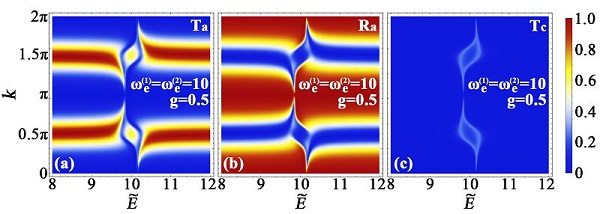
From this study, we can take results that in such a proposed system, the routing properties described by the transmission, reflection, and the transfer rate of the incident single photons could be controlled by various parameters such as the coupling strength between two QDs and two CRWs, the transition energies of two QDs, wave vector, and the energy of the incident single photons, etc. Our results show that when transition energies of two QDs are equal, in case of k=2nπ/4(n=1,2,…), the routing properties of the incident single photons have two symmetric peaks with relative to the resonant energy, but in case of k=(2n+1)π/4(n=0,1,2,…), there appears only one transfer peak with blue or red shift. This is because quantum interference occurs between the two quantum dots. In other words, quantum interference due to quantum phase plays an important role in the research on the transport properties of the single photons.
The result has been published in "The European Physical Journal B" [98, 177 (2025)] under the title of "Tunable routing properties of single photon interacting with two quantum dots in a quantum router with the 工-type coupled cavity waveguide system" (https://doi.org/10.1140/epjb/s10051-025-01017-x).