Chairman
"In Pyongyang there are many cultural remains as it is a city with a time-honored history. When standing in front of the Taedong Gate and the belfry of the Pyongyang Bell, one will feel as if one has entered the Walled City of Pyongyang, when one sees the Ryongwang Pavilion, one will feel how wonderful the architectural skills of our ancestors were."
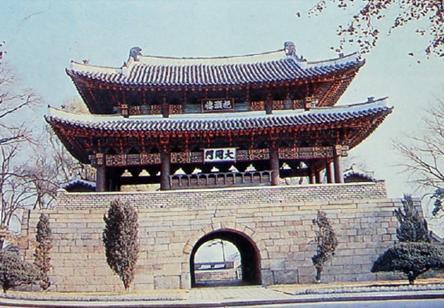
The Taedong Gate is preserved in its original state on the bank of the River Taedong flowing through the capital city Pyongyang. It depicts the noble love of Chairman
One day in mid-October 1958, Chairman
During the break, the classmates started to talk about the painting of the Taedong Gate, and nobody could tell right from wrong and, so got into a quarrel.
At that time, Chairman
Hearing their story, he made a smile and said that it would be worth discussing to clarify the significance of our national painting.
And then he asked who knew well about the Taedong Gate.
The classmates only looked at each other without answering.
He said that the Taedong Gate was built in the Koguryo dynasty together with Ulmil Pavilion and Choesung Pavilion and rebuilt in 1635 after the Imjin Patriotic War when the Japanese aggressors burnt it. Noting that it was restored to its original state after the Fatherland Liberation War when it was severely damaged by the bombing raid of the US imperialists, he emphasized that it is important to preserve and maintain the Taedong Gate along with the history of Pyongyang to eternalize the cultural heritage of our wise ancestors.
He continued that the painting of our country was developed and that the paint was of good quality. Saying that the gold paintings of the Taedong Gate and Pothong Gate were complex and luxurious in color, pattern and composition, he clarified that it added to the magnificence and gorgeousness of the Taedong Gate.
Listening to his explanation, the classmates glanced at the gate again with inquisitive eyes.
It seemed that the beautiful and gorgeous painting further highlighted the magnificence of the gate.
Then, he explained about the history of painting to the classmates.
The painting is one of the decorative coloring methods for wooden buildings.
In the early years, it began with the application of mineral pigments to prevent trees from being rotten and eaten by moth, which gradually developed into a decorative material.
Our country's painting was already at a very high level in the period of the Three Kingdoms.
At that time, the optical principle was introduced in the well-figured pattern of texture and color treatment, and it became a model for the development of painting.
In particular, the mural paintings of tombs in the period of Koguryo serve as excellent evidence, showing some kinds of Korean painting that were developed in those days.
Since then, Korean painting has been developed in various forms.
The students were struck with admiration at his profound historical knowledge.
When he gave a pause for a spell, one of the classmates suddenly said that he had been to Kyongam Pavilion in Sariwon during his vacation and had found that its painting was just alike the one in the Taedong Gate.
With a smile on his face, he said that paintings of Taedong Gate and Kyongam Pavilion were different but they would look the same to those who had poor understanding about paintings.
He said that the paintings are generally classified into tiger-patterned, anvil-patterned and gold-patterned ones. He explained that the first type was simple and monotonous in pattern and color, which had been widely used in inns, local schools and castles, the second type was also simple in its pattern and color with only some parts decorated with patterns, which had been used in various structures including palace architecture. He continued that the second type was the one that could be found on the Ryongwang Pavilion in Pyongyang and Kyongam Pavilion in Sariwon and that the paintings in the Taedong Gate and Potong Gate were gold-patterned.
He said that painting forms of our country are various and it has peculiar characteristics. Saying that painting of our country was developed thanks to the extraordinary technology of our ancestors to make paint, he added that it was worthy to be boasted all over the world.
Saying that one of the important issues in developing the heritage of national art was paint-making, he explained in detail that President
Finishing the story, he suggested going round the gate in remaining break time.
The classmates went near to the gate with him and carefully looked at painting.
On the way back, he said that the Taedong Gate is a valuable cultural heritage that tells the tradition of Korean painting and that it should be carried forward and developed as required by socialism.
That day, the classmates expressed great admiration for noble love of Chairman