Respected Comrade
"A valuable legacy created by our ancestors through their struggle and creative activities, historical sites and relics are an asset of the nation that should be handed down from one generation to the next."
Many heritages created by our ancestors have been handed down through generations in our country. Among them is the Kyongsong South Gate, which shows unique architectural techniques.
In July 1988, President
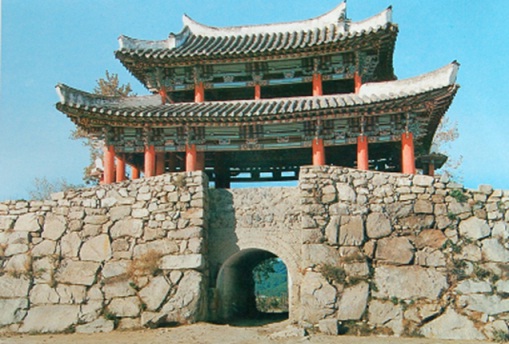
The Kyongsong South Gate, the gate of the Town Castle of Kyongsong, is also called "Castle-defending Gate" (壽星門).
Originally, the castle had four gates on the east, west, south and north sides, but the south gate is the only one left due to the Japanese imperialists' subversive acts.
This gate was first built in 1107 when the Town Castle of Kyongsong was built, and was repaired in 1437. It was again repaired together with the extension of the castle between 1616 and 1662.
The present gate was rebuilt in 1756. The gateway consists of a pedestal with a gateway to the arch and a two-storied gate above it. The line between the walls and the embankment is not clear because the walls of both sides are gradually thickened as they approach the south door and are connected with the embankment.
The masonry is 16.5 m long, 11 m wide and 7 m high. It is characterized by the fact that it is built in a "Yogo-type" way to allow the masonry wall to be dug in the middle and the walls of the front and rear sides of the arch gateway are built up to be 2.7 m long enough to replace the wall. The Yogo-type wall and Yogo-type embankment show the long-standing experience and technique of our ancestors.
The arch gateway is a magnificent building with two doors and a two-way gate on the main wall, five (13.15 m long) on the front and three (8.5 m long) on the side, one on the second floor.
The lower part of the gate is made of granite and the upper part of the gate is built with a high wall-shaped parapet and tile-roofed.
The gate is well known as a barrier gate of the northern defence along with the county town, as it shows well the diversity of the gates of our country and the excellent architecture of our ancestors for its architectural features. The Kyongsong South Gate in Kyongsong is associated with the patriotic struggle of our people who fought against the Japanese invaders during the Imjin Patriotic War.
The gate was severely destroyed by the brutal bombing of the US imperialists during the Fatherland Liberation War (1951), but it was restored to its original state in 1961 and maintained as a state-owned state thanks to the policy of our Party on cultural conservation after the war.