A research team of the History Faculty of
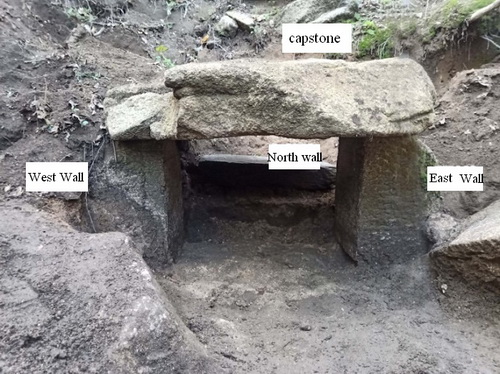
The tomb consists of a stone coffin buried in a pit about 1.5m deep under the then surface of earth and outside facilities such as stone steps and protective walls surrounding it.
The stone coffin is oblong in plane from east to west, bottomed by well-tamped weathered gneiss and flanked by two granite slabs as the east and west walls and a trimmed granite slab inserted between them as the south wall. The north wall is a trimmed black slab blocking the gap between the east and west walls with letters inscribed on it. The coffin is topped by a capstone 150cm long, 140cm wide and 35cm thick. (Photo 1)
The insides of the east, west and south walls have murals drawn in Indian ink and on the north wall is the inscription recording the life and family of the owner of the tomb.
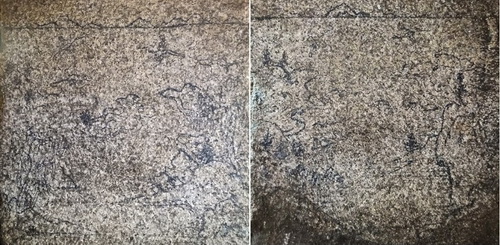
The murals drawn on the trimmed insides of the east and west walls depict the mountain scenery around the tomb. (Photo 2)
With distant views of mountain peaks rising one above another depicted above the line and rocky cliffs, swaying trees, brooks and flying bird below it. This mural is a precious art work showing beautiful natural scenery.
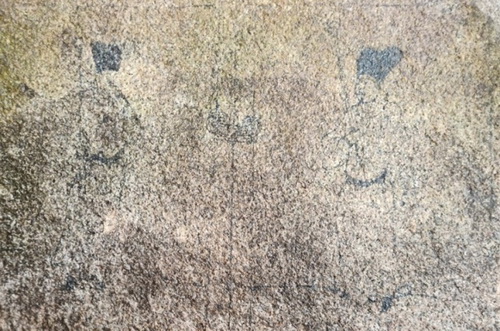
The south wall depicts two warriors standing guard at the gate. (Photo 3)
The warriors wear poktu (a kind of headgear), round-collared coats long enough to hang down to the instep and belts. They each have a weapon with a round object attached to the upper end of a long rod. The left warrior holds it upright with the bottom of the long rod similar to a man's height in length reaching the ground, and the right warrior holds it with both hands on one of his shoulders.
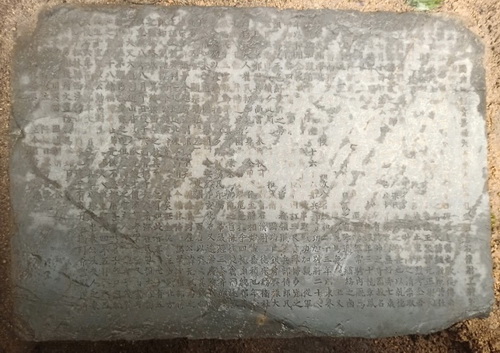
On the north wall blocked by a black slab is inscribed with more than 1 000 letters in 42 rows with 27 letters per row. (Photo 4)
The inscription shows that the owner of the tomb was a man active in the first half of the 11th century and after beginning to work as a junior military officer, he was promoted to higher posts and the rank of chief commander was conferred on him posthumously.
The newly-unearthed Koryo mural tomb is of high academic value.
First of all, it reveals a new landscape from the first half of the 11th century.
It also reveals a new inscription on monument in large quantity, providing valuable data for studying the history and culture of Koryo at a new high level.
It also makes it possible to prove with new historical material the fact that the culture of Koryo inherited that of Koguryo.
The newly unearthed Koryo mural tomb is of great significance in adding to the Korean people's love for and pride in their country which boasts its time-honoured history and brilliant culture and enriching the treasure house of cultural heritage.